On top
Command Center
One center where the network is followed in real time.

 PT
Talk to Onni


CDA initiative · Onni + Cisco · Municipalities across Brazil
Data, AI agents, observability and security working together, so a municipality can see its whole health network and act on what matters to the citizen.
01 What the project is
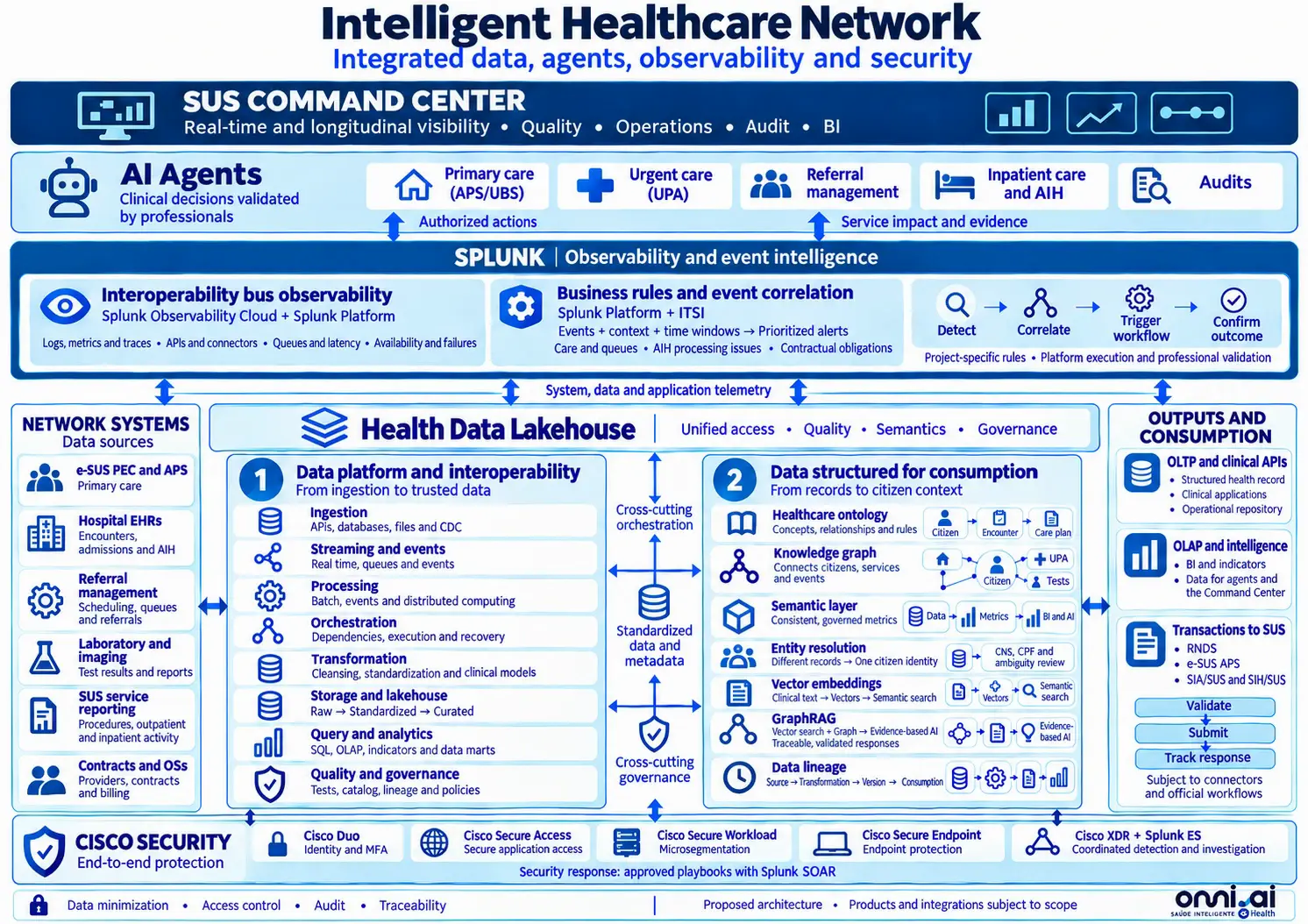
The smart health network: data, agents, observability and security integrated. Open at full size
Today, each point of care keeps its own records in its own system. The smart network connects them without replacing them. The citizen’s journey becomes one continuous story, the manager sees the whole network in one view, and professionals get AI support during care, always keeping the decision.
How to read the diagram
On top
One center where the network is followed in real time.
At the point of care
Support for UBS, UPA, regulation, admissions and auditors. Professionals validate clinical decisions.
Watching everything
Detects what went off course and shows who needs to act.
In the middle
Connects existing systems and turns their records into reliable information.
Around it all
Protects people, equipment and services from end to end.
Proposed architecture. Products and integrations are defined in the scope of each municipality.
02 Command Center and AI agents
An AI assistant that follows the visit from start to finish: it listens, organizes the record and checks protocols, so the professional looks at the patient and not at the screen.
Specialized programs, each with one task, like a support team behind the scenes. Everything reaches the professional ready for review.
A center where AI agents, doctors and nurses manage the citizen’s journey in real time, from primary care to production.
1 · At the UBS
The AI prepares and suggests. The professional reviews, decides and signs.
2 · At the UPA
The copilot organizes and flags. The nurse defines the risk classification.
3 · At the Command Center
Primary care, regulation, UPAs and production in one view. Doctors, nurses and agents act together.
03 What the bus is
Think of a translator in the middle of the network. Each system keeps working as it does today, in its own format, and speaks only to the bus. The bus translates, organizes and delivers the information to whoever needs it.
Current systems stay where they are and remain the official record of each point of care.
What each unit records about a citizen comes together in one place, with the source and date of every item.
The bus brings what is happening. Clinical intelligence says what should happen. The Command Center works on the difference.
04 Inside the bus
The whole journey in the municipal network
Who gains what
The full history at the moment of care.
The queue with the clinical context needed to decide.
The view of the network, and SUS production checked before it is sent.
One monitored integration point, with an error queue and reprocessing in one click.
Every access recorded, with purpose and justification.
Privacy applied at every reading
A professional reads the history only of those in their care.
Every reading says what it is for. Without a purpose, it is refused.
Each role sees only what the work requires.
05 The Splunk layer
Splunk connects the technical condition of the platform to the performance of the health service. It identifies deviations, links related events and shows the Command Center the impact, who is responsible and the result of the response.
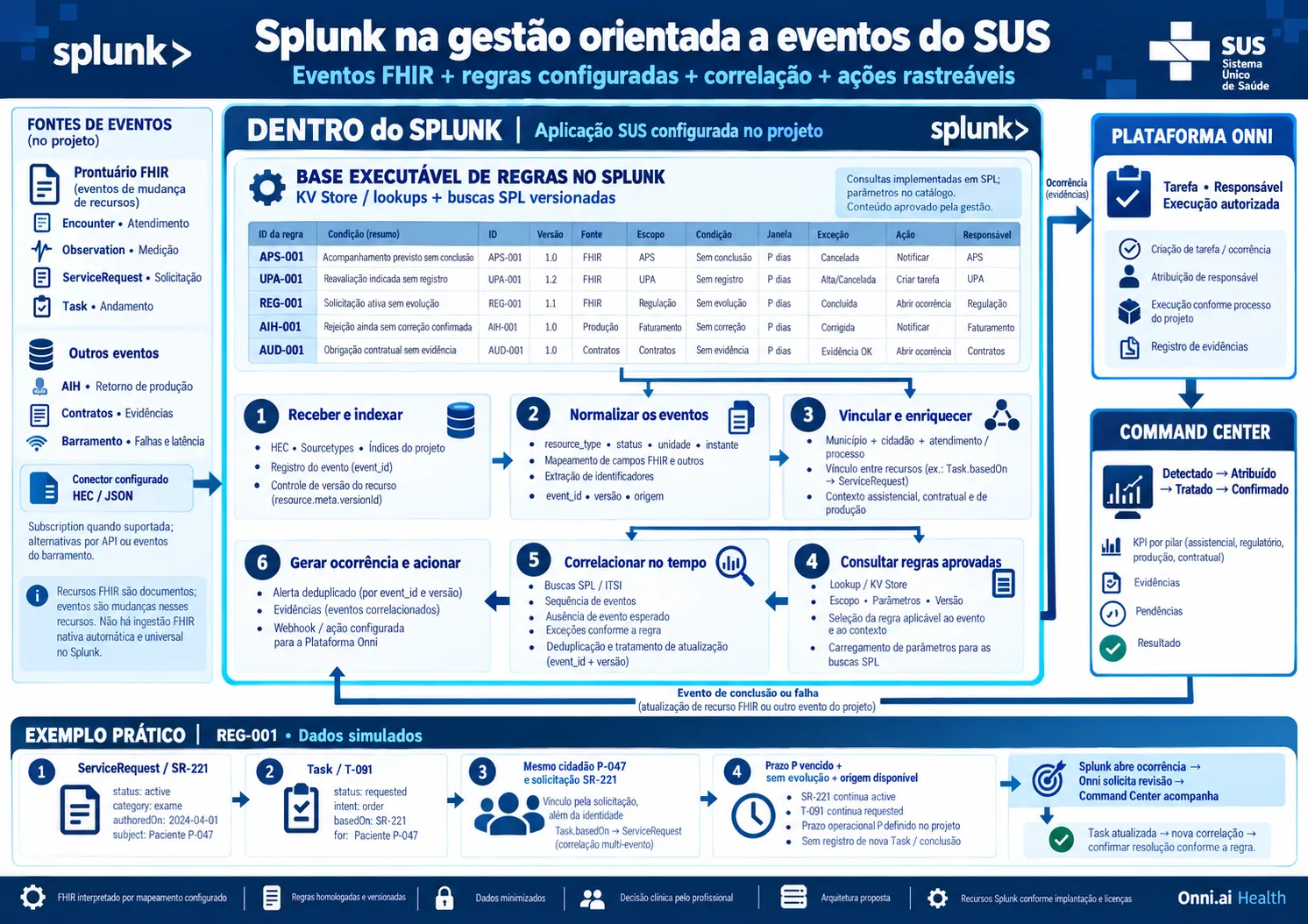
Splunk in event-driven SUS management. The example uses simulated data. Diagram in Portuguese. Open at full size
Examples of rules applied to health
Rules are defined and approved by the health department and those clinically responsible. An alert does not replace a clinical decision.
06 The smart cabin at the UBS and the UPA
The cabin combines Cisco collaboration devices, Meraki connectivity and Onni software to offer assisted measurements, teleconsultation and an integrated record. At the UBS it supports follow-up and access to remote support. At the UPA it supports reception and risk classification by the nurse.
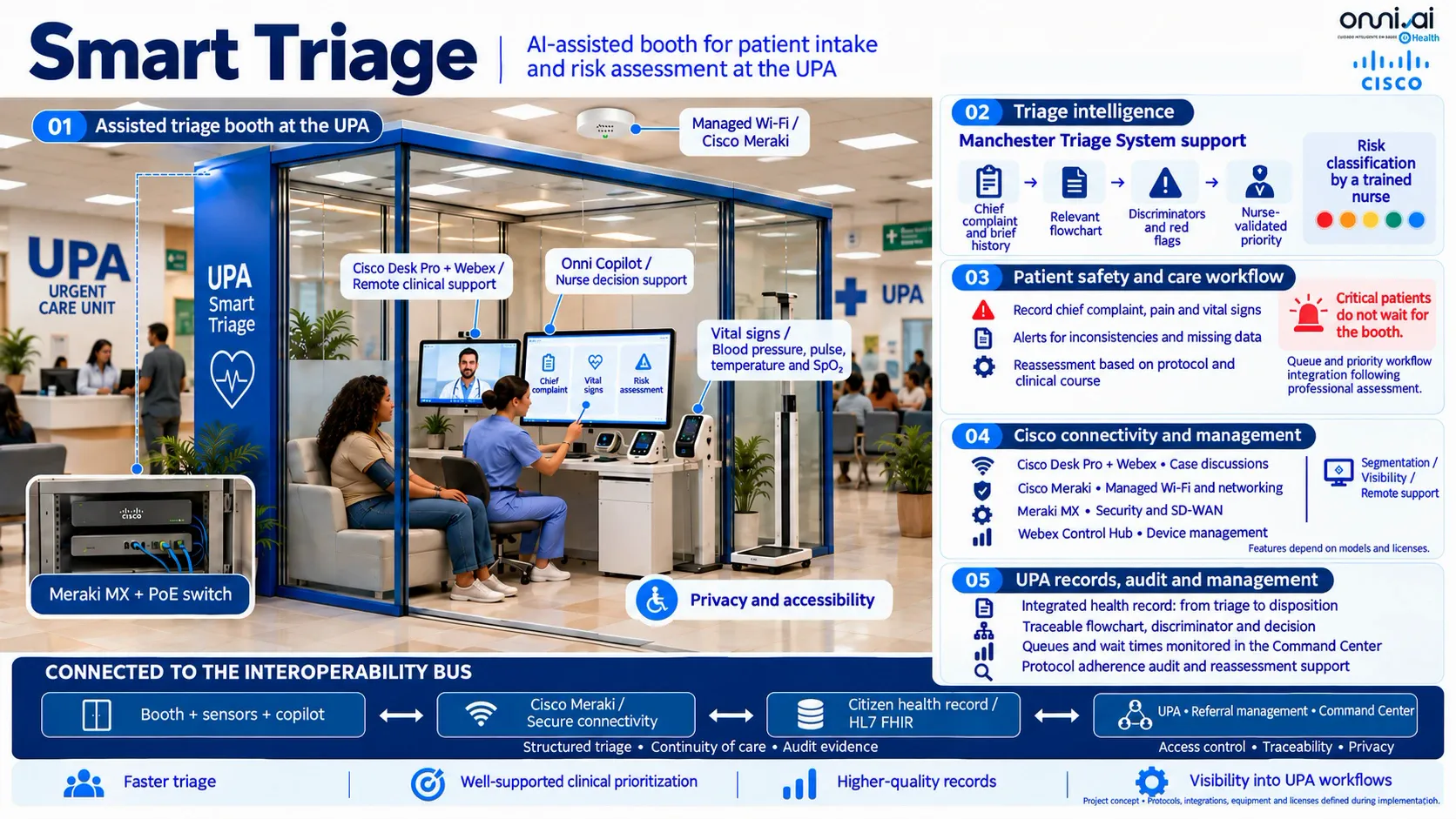
Smart Triage: the cabin in its UPA version. The infrastructure is the same at the UBS; the care flow adapts. Project concept. Open at full size
Three layers working together
Bring the local team closer to remote support, with video and audio.
Carries the unit’s traffic securely and applies the network’s policies.
Connects sensors, Onni agents and the medical record through the bus.
The Cisco devices
Screen, camera and audio for assisted teleconsultation and case discussion.
Manages devices remotely: setup, updates and diagnosis.
Managed wireless network, with policies defined by the project.
Organizes wired connections and makes diagnosis and expansion easier.
Unit security and SD-WAN: connects the unit to central services.
One place to manage the Meraki equipment of every unit.
Blood pressure, temperature, pulse, oxygen, weight and height sensors are clinical equipment of their own. The network carries the data; it does not interpret its clinical meaning. Models, quantities and licenses depend on sizing.
07 Benefits and innovation in the SUS
Citizen
Follow-up of measures, pending items and next steps, closer to home.
Professional
Less manual recording and the protocol in plain sight during care.
Manager
The whole network in one view, anticipating disallowances and transfer problems.
IT
Several cabins supported without depending only on on-site visits.
Expected benefits. Efficiency results are assessed against each municipality’s baseline, with no prior guarantee.
08 The Cisco security layer
Security protects the connection between professionals, cabins, legacy systems and platform services. The goal is to reduce exposure and limit the reach of incidents, keeping controlled access to care and management.
Example: an incident at the cabin
These controls are complementary architectural options, chosen by risk, existing environment and licenses. Who may access each medical record is decided in the Onni application and the clinical systems, by role, unit and purpose.
An initiative with Onni and Cisco, working with municipalities across Brazil.