Enterprise AI Acceleration Platform
AI is everywhere. Transformation isn't.
Turn AI into how your company works.
People
What AI would you putin the hands of every employee?
Business
How would you put AIinside your core business?
Onni solves both.
One architecture.Two acceleration engines.
Question one · People
What AI would you put in the handsof every employee tomorrow?
- A ChatGPT?
- A copilot?
- A catalog of agents?
- Or an AI that actually knows their work?
Onni Fabric
Don't give everyonethe same AI.Give everyone an AI thatknows their work.
Fabric turns roles, activities, knowledge, rules and processes into an intelligent workspace for every employee.
Fabric Understand work. Augment people. Measure productivity. Learn continuously.
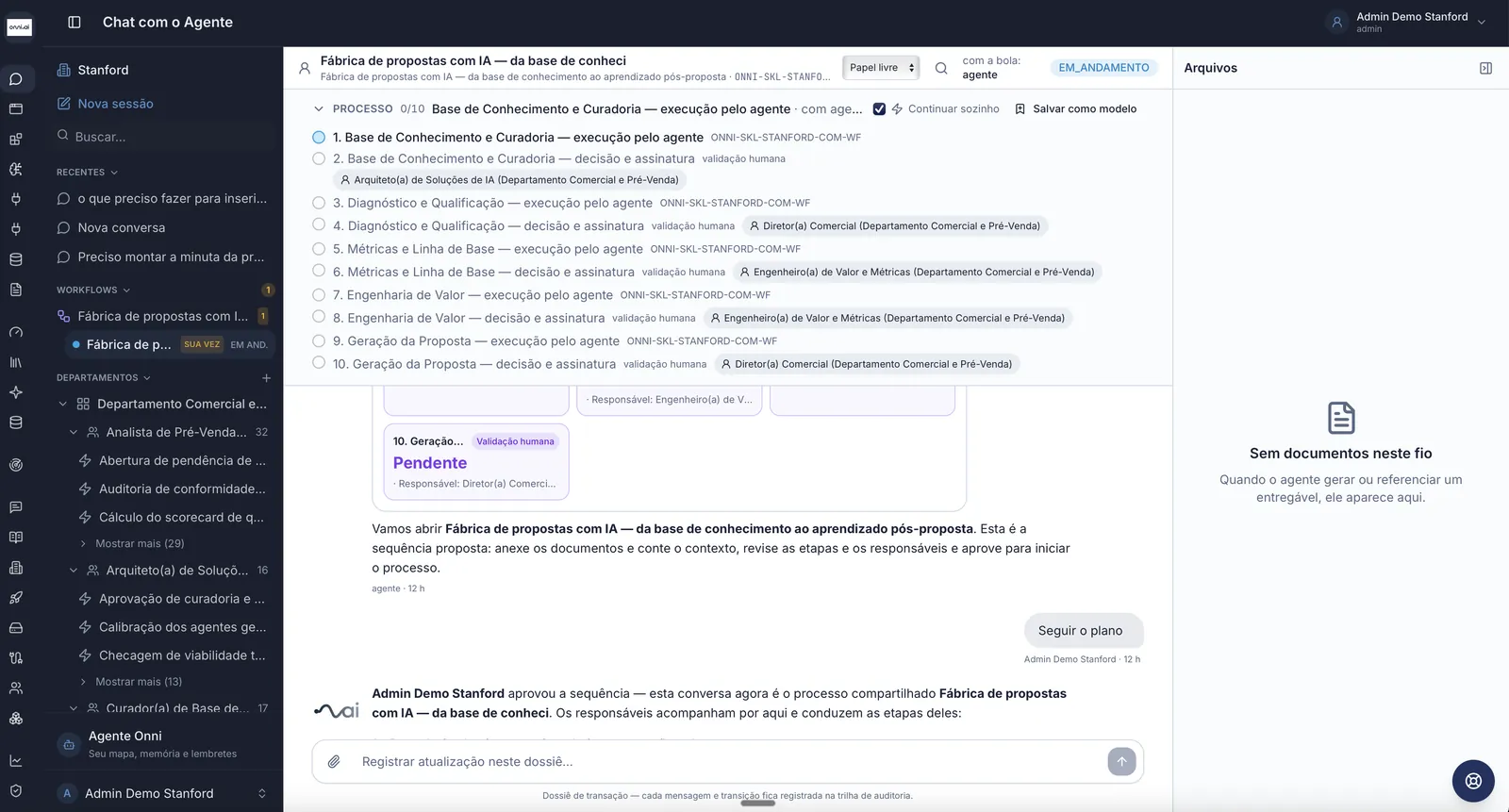
Mariana CostaCommercial Director
Your work
- 12 core activities
- 8 workflows
- 4 high AI-potential activities
- 3 approvals you own
- 2 pending today
I need to prepare the ACME proposal.
Fabric doesn't answer like a generic chatbot. It already knows:
- Activity
- Skill
- Process
- Rules
- Knowledge
- Approvals
- Result
- KnowUnderstands the work.
- ExecuteExecutes activities.
- MeasureMeasures productivity and gain.
- LearnLearns from real use.
But how does Fabric know what each person does?
We mapped workbefore automating it.
- APQC PCF v8processes
- CBOBrazilian occupations
- O*NETtasks and skills
- Anthropic Economic IndexAI exposure
- Regulations & standardsISO 9001, PMI, SHRM
- Your companypolicies, documents, data
- Role
- Activities
- Skills
- Rules
- Knowledge
- Execution
Before automating work, understand work.
Before measuring AI,set the human baseline.
Before AI
3h 00m
Manual effort, reference
With Fabric
8m 42s
Execution, measured
2h 51m returned.
Fabric compares every execution with the manual reference: time, tokens, cost, human interaction and gain.
Transform your workforceBut individual productivitydoesn't transform a company.
Core processes do.
Question two · Business
How would you accelerate AIin your core business?
- Which process first?
- Which benefit?
- Which architecture?
- Which agent?
- Which data?
- Which knowledge?
- Which rule?
- Which risk?
- Which integration?
- Who approves?
- How to measure?
- How to govern?
This is not a chatbot problem.It's an enterprise transformation problem.
Most AI programs invest in the 30%.Transformation happens in the 70%.
The 10-20-70 rule, Boston Consulting Group.
Onni turns the 70% into engineering.
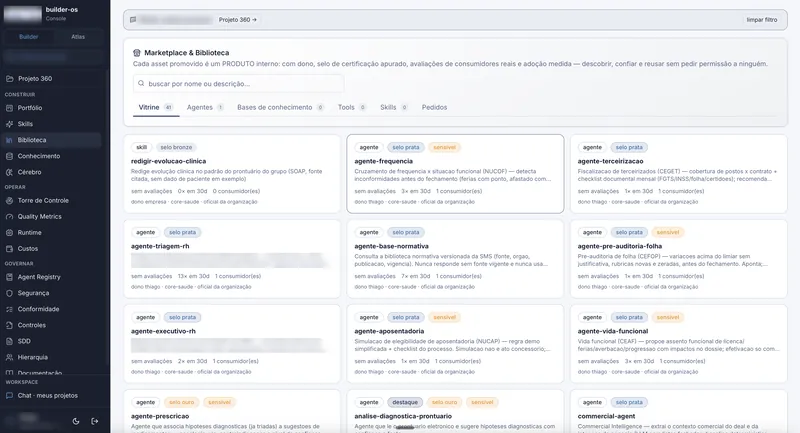
Onni Builder
From business intentto governed production.
Builder Redesign processes. Build capabilities. Execute dynamically.
- “Reduce opportunity-to-contract cycle time.”
- 01 Understand
- 02 Diagnose
- 03 Redesign
- 04 Build
- 05 Execute
- 06 Measure
Live case · Revenue-to-Cash · TodayBottlenecksRedesigned
“Reduce opportunity-to-contract cycle time.”
Don't automate bureaucracy.Redesign it.
- CRM
- Proposal
- Pricing
- Finance
- Legal
- Contract
- Signature
Queues and rework between handoffs
But how does it scale to hundreds of processes?
Processes don't call agents.Processes require capabilities.
- Business intent
- Process
- Capability
- Discovery
- Policy
- Routing
- Agent
- Tools / systems
The Builder manifesto
- Build once.
- Publish capabilities.
- Discover at runtime.
- Compose dynamically.
- Route intelligently.
- Govern centrally.
- Execute anywhere.
- Prove every decision.
- Learn continuously.
What happens to everything AI creates?
Everything your AI learnsshould compound yourenterprise intelligence.
Atlas Governance as a by-product of engineering.
Preserve architecture. Connect knowledge. Govern continuously. Models and vendors change; what your AI learns stays in your enterprise graph, documented while it is built and run.
Transform your core business- Process
- Capability
- Agent
- Knowledge
- Data
- Decision
- Evidence
- ATLAS
One vision. One platform.Two speeds of transformation.
AI transformation fails when peopleand processes move at different speeds.
Productivity ↑Enterprise transformation →
Technology ↑Adoption ↓
Scale ↑Transformation ↑
Accelerating AI requires individuals and the company to share the same vision, the same knowledge and the same work platform.
AI Strategy
The questions that defineyour AI strategy.
AI doesn't start with choosing a model. It starts with asking the right questions.
- Which AI for everyone?
- Where should AI be applied?
- Do I need to train my data?
- RAG or fine-tuning?
- Do I need my own model?
- How do I connect legacy?
- When should I use agents?
- How do I protect my data?
- How do I govern agents?
- How do I measure ROI?
- How do I keep sovereignty?
Built forenterprise reality.
- ExperienceApps · Chat · Copilots · Voice · APIs
- Intent & processBusiness intent · process models · SLAs
- Enterprise agent control planeRegistry · Discovery · Policy · Router
- Agent runtimeA2A · Agents · Memory · Context
- Capability & tool fabricMCP · APIs · Events · Workflows
- Enterprise systemsSAP · Salesforce · TASY · Oracle · Legacy
- Data & knowledgeRAG · Graph · Documents · Databases
- Security · Identity · Observability · Evaluation · FinOps · Audit · Governance
You don't need to replace your enterpriseto become AI-native.
- SAP
- Salesforce
- Oracle
- Java
- Mainframe
- Data lake
- Documents
- APIs
- Legacy
Refactor what matters. Integrate what works.Build what is missing.
Same architecture.Different intelligence.
Healthcare
- Patient
- Triage
- Clinical decision
- Regulation
- Hospital
Telecom
- Customer
- Interaction
- Quality
- Churn
- Retention
Government
- Citizen
- Request
- Eligibility
- Process
- Decision
Financial services
- Customer
- Risk
- Compliance
- Decision
- Transaction
Industry
- Operation
- Quality
- Maintenance
- Supply chain
The platform stays. The domain changes.
Fabric in production
Proof
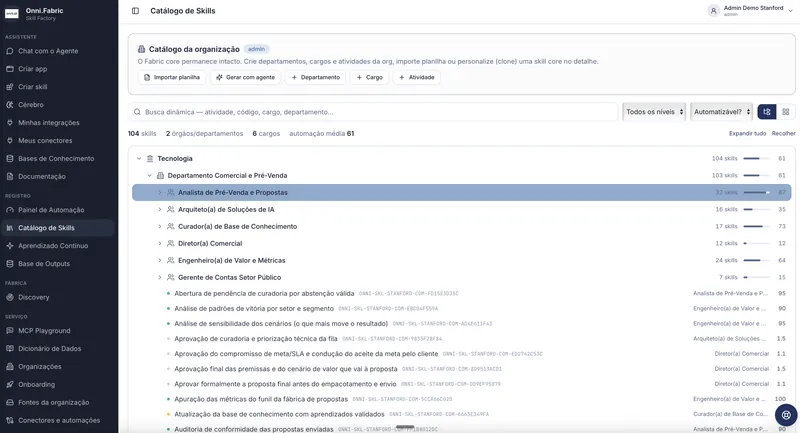
Mapped for every role
- Activities / skills
- 27,320
- Business rules
- 148,027
- Indexed documents
- 2,392,234
- Learning deltas
- 10M
It doesn't start empty.And it doesn't stop learning.
Not just software
The Onni Method.
- 01DiscoverWhat work matters?
- 02MapHow does it operate today?
- 03RedesignWhat should change?
- 04BuildWhat capabilities are required?
- 05ExecuteHow should AI and humans operate?
- 06GovernCan every decision be explained?
- 07MeasureDid it create value?
- 08LearnWhat should become the new standard?